TDS on Rent in India: Rates, Rules and How to Manage Compliance in 2026

Contents
- What Is TDS on Rent?
- When Does TDS Apply to Rent and How Much Is Deducted?
- How Does the TDS Process Work?
- What Happens to the Rent After TDS Is Deducted?
- Why Managing TDS Manually Can Become Difficult
- How Realtimate Simplifies TDS on Rent
- Final Thoughts
- Frequently Asked Questions
Rent collection may seem like a straightforward transaction: a tenant pays rent and the landlord receives it. But when Tax Deducted at Source (TDS) applies, the payment involves another important step.
The tenant or person responsible for making the payment may have to deduct tax from the rent, deposit that tax with the government and report the deduction through the applicable TDS process.
The rules are not identical for every rental transaction. The applicable treatment depends on factors such as whether the landlord is resident or non-resident, who is paying the rent, the type of property being rented, and the applicable threshold.
There is also an important change for anyone reading older articles on rent TDS. From 1 April 2026, the Income-tax Act, 2025 applies, and the relevant rent-TDS provisions are consolidated under Section 393. The older provisions such as Sections 194-I and 194-IB of the Income-tax Act, 1961 should therefore not be presented as the current section numbers for payments made under the new Act.
What Is TDS on Rent?
Tax Deducted at Source (TDS) is a mechanism through which tax is collected when certain payments are made.
In the case of rent, the person responsible for making the payment deducts the applicable TDS from the amount payable to the property owner and deposits the deducted amount with the Central Government.
For example, if a company pays ₹1,00,000 per month as rent for an office space and TDS applies at 10%:
- Gross rent: ₹1,00,000
- TDS deducted: ₹10,000
- Net rent paid to owner: ₹90,000
- TDS deposited with government: ₹10,000
The TDS is therefore not an additional amount paid by the tenant on top of the rent. It is deducted from the amount payable to the property owner.
When Does TDS Apply to Rent and How Much Is Deducted?
Not every rent payment is subject to TDS. The applicable rule depends mainly on who is paying the rent and whether the landlord is resident or non-resident.
For rent paid to a resident landlord, the key threshold is ₹50,000 for a month or part of a month. The rate and timing of deduction depend on the category of the payer and the type of rent.
When an Individual Pays Rent
TDS on rent is not limited to businesses.
An individual or HUF covered by the separate rent provision is also required to deduct TDS when rent exceeds ₹50,000 per month or part thereof.
For the resident land/building rent covered here, the applicable rate is 2%.
Unlike the business category below, an individual or HUF covered by this provision does not use the regular TAN-based process. The payer uses their PAN login on the Income Tax e-Filing portal to file Form 141, the challan-cum-statement for specified PAN-based TDS transactions.
Form 141 combines the TDS payment and reporting for these transactions. Once the form is filed and the payment is completed, the challan/acknowledgement can be retained as proof of the TDS payment.
The deducted TDS must be paid and Form 141 furnished within the applicable time limit. The prescribed TDS certificate, Form 132, can subsequently be downloaded through TRACES and provided to the property owner.
When a Business Pays Rent to a Resident Landlord
When a company, firm or other specified person pays rent to a resident property owner for land or a building, TDS generally applies when the rent exceeds ₹50,000 in a month or part of a month.
For the type of rental property covered in this article, the applicable TDS rate is generally 10%.
For example, a company paying ₹1,00,000 per month for an office building would deduct TDS at the applicable rate before making the landlord's payment.
A specified person generally refers to a person other than an individual or HUF. An individual or HUF may also fall within this category where the prescribed business or professional turnover conditions are met.
Businesses and other specified persons must generally use the TAN-based TDS process to deduct, deposit and report TDS. TDS is generally deducted when the rent is paid or credited and deposited within the applicable due date, while the corresponding TDS statement is furnished according to the prescribed reporting schedule.
After the applicable TDS statement is processed, the deductor must issue the prescribed TDS certificate, Form 131, to the property owner under Section 395(4) of the Income-tax Act, 2025.
If TDS is deducted but deposited late, interest may apply at 1.5% per month or part of a month until the tax is actually deposited. Failure to deduct TDS on time can also attract interest at 1% per month or part of a month.
What If the Landlord Is an NRI?
Rent paid to an NRI or other non-resident landlord follows different TDS provisions from rent paid to a resident landlord. The resident ₹50,000 monthly threshold should not simply be applied to NRI rent. The applicable rate depends on the rates in force, along with surcharge, cess, DTAA provisions and the specific circumstances of the payment.
For example, where a 30% base rate applies and 4% Health and Education Cess is applicable, the effective rate would be 31.2%, assuming no surcharge or other adjustment applies. However, 31.2% is not a universal TDS rate for every NRI landlord.
An NRI property owner may apply for a Lower Tax Deduction Certificate (LTDC) to have TDS deducted at a lower or nil rate where applicable. Under the Income-tax Act, 1961, this was covered under Section 197; from 1 April 2026, the corresponding provision is Section 395(1) of the Income-tax Act, 2025. The property owner/payee applies for the certificate, and the payer uses the approved rate when deducting TDS.
If you are unsure how to apply for or obtain an LTDC, you can reach out to Realtimate for assistance with understanding the process and required documentation.
NRIs should provide accurate residential-status and tax information and should not use a false Indian address to obtain lower TDS. For example, incorrectly treating an NRI as a resident could result in short deduction of TDS, interest and other tax-compliance consequences.
Is the Threshold ₹50,000 a Month or ₹6 Lakh a Year?
This is an important distinction.
The threshold is ₹50,000 per month or part thereof. Although ₹50,000 multiplied by 12 equals ₹6 lakh, ₹6 lakh is not a separate annual threshold under the provision. The law specifically refers to the amount for a month or part of a month.
For example, if the monthly rent is ₹60,000, the applicable monthly threshold has already been crossed. There is no requirement to wait until cumulative rent reaches ₹6 lakh.
Therefore, it is more accurate to describe the rule as a ₹50,000 monthly threshold, rather than an annual ₹6 lakh limit.
How Does the TDS Process Work?
The Two Parts of TDS Compliance
TDS compliance has two closely connected parts:
1. Paying the TDS
The deducted TDS amount must be deposited with the Government within the applicable due date.
2. Filing and reporting the TDS
For Individuals and HUFs covered by the rent provision, the deduction and payment are reported through Form 141, the challan-cum-statement filed through the PAN login on the Income Tax e-Filing portal.
Once these two parts are understood, the TDS process can be broken down into five practical steps:
Steps in the TDS Process
1. Identify the landlord
The first step is to identify the landlord and confirm the applicable TDS requirements.
2. Identify the payer
For rent paid to a resident landlord, the payer's category needs to be established. The rules differ for specified persons and individuals or HUFs covered by the separate rent provision.
3. Determine the applicable rate
The applicable rate depends on the type of rent and the category of payer.
For example, businesses deduct TDS at 10% on rent for land or buildings. Certain individuals and HUFs apply 2% under the separate rent provision.
4. Deduct the applicable TDS
The required amount is deducted from the rent payable to the landlord at the applicable time.
The timing is not identical for every category. For example, under the resident rent provision applicable to a person other than a specified person, the deduction is made for the last month of the tax year or tenancy, as applicable.
5. Pay and report the TDS
After deduction, the TDS must be deposited with the Government within the applicable deadline. The deduction and payment must then be reported through the applicable TDS statement or challan-cum-statement on the Income Tax e-filing system. The relevant TDS certificate should also be provided to the property owner.
For property managers handling multiple rental transactions, keeping these steps organised can become increasingly difficult when each transaction is managed separately.
What Happens to the Rent After TDS Is Deducted?
When TDS applies, the rent is divided into two components:
Gross rent payable = Net amount paid/credited to the landlord + TDS Deposited with Government
The landlord receives the amount remaining after the applicable TDS has been deducted. The deducted amount is deposited with the government and is generally available to the landlord as TDS credit, subject to the applicable tax rules.
This distinction is important when managing rental accounts because the amount collected from a tenant and the amount ultimately received by a landlord may not be the same.
A property manager therefore needs to maintain a clear record of the transaction from the original rent amount through to the final distribution.
Why Managing TDS Manually Can Become Difficult
For a single rental property, keeping track of TDS may be relatively straightforward.
The situation changes when a property management company handles dozens or hundreds of properties with multiple tenants and landlords.
A single rental portfolio can involve:
- Different landlords
- Different ownership structures
- Resident and non-resident owners
- Multiple rental payments
- TDS calculations
- Tax payments
- Landlord disbursements
- Bank reconciliation
- Transaction records
When these activities are managed through separate spreadsheets, bank accounts and TDS records, the financial trail can become difficult to follow.
A property manager may need to determine whether the amount collected from a tenant matches the expected rent, whether the appropriate deduction was made, whether the TDS payment was completed and whether the correct amount was ultimately disbursed.
The challenge is therefore not simply calculating TDS. It is keeping the entire rental transaction organised from collection through to final disbursement.
How Realtimate Simplifies TDS on Rent
For property management businesses, rent collection, TDS and owner disbursements are closely connected. Managing each activity separately can create additional reconciliation work.
Realtimate brings rent collection, escrow, TDS and disbursement into a connected property management workflow.
Rent can be collected from tenants across multiple properties through the platform, with TDS computation, deduction and tracking handled within the same workflow.
This creates a connected flow:
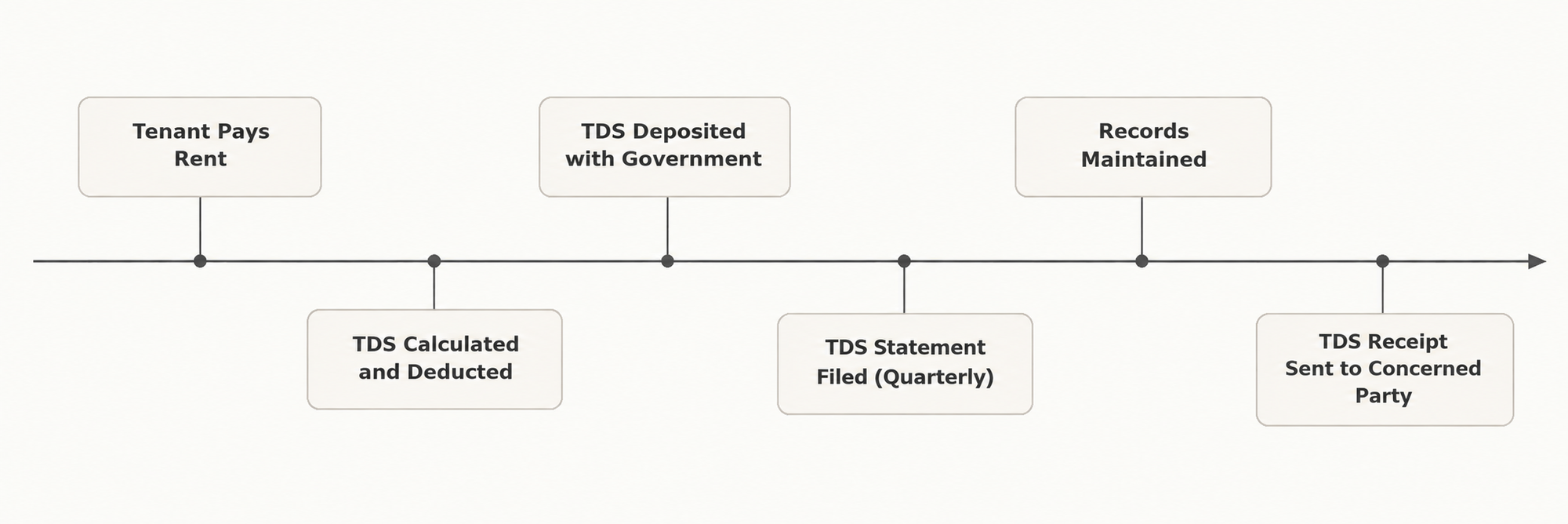
Realtimate also supports disbursement across multiple owner entities, helping property management businesses manage rental transactions involving different ownership structures.
By bringing collection, TDS and disbursement together, Realtimate helps property managers reduce fragmented administrative work and maintain a clearer transaction trail as their portfolio grows.
Final Thoughts
For property management businesses, the challenge with TDS extends beyond understanding the applicable tax rate. Rental operations involve collection, deductions, tax payments, reconciliation and disbursement, all of which need to remain connected.
A centralised workflow can make these transactions easier to manage as the number of properties, tenants and landlords grows.
With Realtimate, rent collection, escrow, TDS and disbursement are brought together in one platform, giving property managers a more structured way to manage rental transactions at scale.
Frequently Asked Questions
Who is responsible for paying TDS on rent?
When TDS applies, the person making the rent payment is responsible for deducting the applicable TDS and depositing it with the government. The landlord receives the rent after the applicable TDS has been deducted.
What happens when rent is paid to an NRI?
Rent paid to an NRI is governed by the non-resident TDS provisions rather than the resident ₹50,000 monthly threshold. The applicable rate in force must be considered, along with any applicable surcharge, cess and DTAA relief.
How does Realtimate handle TDS on rent?
Realtimate integrates TDS computation, deduction and tracking into its rent collection workflow, alongside escrow-based collection and disbursement.