Aadhaar eSign: A Smarter Way to Sign Documents Online
A complete guide to Aadhaar eSign and how it works, whether it's legally valid, which documents you can sign, and why it's one of the easiest ways to sign documents securely in India.
Contents
- What Is Aadhaar eSign?
- Why Choose Aadhaar eSign?
- Is Aadhaar eSign Legally Valid in India?
- Where Can You Use Aadhaar eSign?
- Which Documents Cannot Be Signed Using Aadhaar eSign?
- How Aadhaar eSign Works
- Is Aadhaar eSign Safe?
- Final Thoughts
- Frequently Asked Questions
Remember when signing a document meant printing it, finding a pen, signing every page, scanning it, and sending it back?
Thankfully, those days are slowly becoming a thing of the past.
Today, you can sign many documents in minutes using your phone or laptop. Whether you're accepting a job offer, signing a rental agreement, completing loan paperwork, or signing a service agreement with a new client, digital signing has made the entire process much simpler.
One of the most convenient ways to do this in India is Aadhaar eSign.
But if you've never used it before, you probably have a few questions.
What exactly is Aadhaar eSign? Is it legally valid? How does it work? Can you use it for every document?
Don't worry. We'll answer all of these questions in this guide, so you know exactly when and how to use Aadhaar eSign with confidence.
What Is Aadhaar eSign?
Imagine you've just received an employment contract or a rental agreement that needs your signature. Instead of printing the document, signing it by hand, scanning it, sending it back, and waiting through another round for the other party's counter-signature, you can complete the entire process online in just a few minutes using Aadhaar eSign.
Simply put, Aadhaar eSign is a secure way to sign documents online by verifying your identity through UIDAI, the authority that manages Aadhaar in India.
Unlike a Digital Signature Certificate (DSC), you don't need a USB token or any special software. All you need is:
- Your Aadhaar number or Virtual ID (VID), depending on the platform
- A mobile number linked to your Aadhaar
- An OTP to verify your identity
Once your identity is verified, your digital signature is securely applied to the document, and the entire process is usually completed almost instantly.
Why Choose Aadhaar eSign?
So, why are more people choosing Aadhaar eSign? Here are three reasons why it has become a preferred way to sign documents online.
1. Convenience
Everything happens online. There's no need to:
- Print documents
- Scan pages
- Visit an office
- Send couriers
Whether you're in Bengaluru, Delhi, or even overseas, you can sign eligible documents remotely as long as you can complete Aadhaar authentication.
Multiple people can also sign the same document without being physically present.
2. Trusted and Legally Recognised
Aadhaar eSign offers a reliable way to sign documents online while verifying the signer's identity through Aadhaar authentication. Since it is recognised under the Information Technology Act, 2000 for eligible use cases, it is widely accepted for many business, financial, and administrative processes. This gives both parties greater confidence in the authenticity of the signed document.
3. Saves Time and Cost
Traditional paperwork often involves:
- Printing
- Courier charges
- Manual approvals
- Delays
Depending on the platform, Aadhaar eSign may involve a small fee per signature or be included as part of the service.
Most documents can be signed within minutes instead of days. It also reduces paper usage and administrative work.
Is Aadhaar eSign Legally Valid in India?
Yes.
Aadhaar eSign is legally recognised in India through multiple laws and regulations:
- Section 3A of the Information Technology Act, 2000, which recognises electronic signatures that follow prescribed procedures.
- Information Technology (Electronic Signature or Electronic Authentication Technique and Procedure) Rules, 2015, which establish the Aadhaar eSign framework.
- Ministry of Electronics and Information Technology (MeitY) notifications and guidelines, which prescribe the technical and procedural requirements that Aadhaar eSign service providers must follow.
- Bharatiya Sakshya Adhiniyam, 2023, which governs the admissibility of electronic records and secure electronic signatures as evidence.
One important legal advantage is that Aadhaar eSign qualifies as a Secure Electronic Signature under Indian law.
This means courts may presume that the signature is authentic unless evidence is produced to prove otherwise.
However, Aadhaar eSign only confirms the signer's identity. It does not replace other legal requirements, such as stamp duty, notarisation, or registration, where these are required by law.
Where Can You Use Aadhaar eSign?
From employment paperwork to property agreements, Aadhaar eSign can be used for a wide range of personal and business documents, including:
- Rental agreements
- Employment offer letters
- Appointment letters
- Non-Disclosure Agreements (NDAs)
- Vendor agreements
- Service agreements
- Loan documents
- Insurance forms
- Educational forms
- Declarations
- Affidavits (subject to any additional legal requirements)
- Agreements for salewh
Which Documents Cannot Be Signed Using Aadhaar eSign?
While Aadhaar eSign can be used for many everyday documents, it isn't suitable for every type of legal document. Some documents still require physical signatures or additional legal formalities to be legally valid.
Under Schedule I of the Information Technology Act, 2000, Aadhaar eSign cannot be used for certain documents, including:
- Wills and other testamentary documents
- Promissory notes
- Bills of exchange
- Trust deeds
- Certain powers of attorney, especially those related to immovable property
These documents are excluded because they often involve additional legal requirements, such as physical execution, registration, notarisation, or witnessing. Aadhaar eSign does not replace these legal formalities.
One notable update came in 2022. The Ministry of Electronics and Information Technology (MeitY) amended the First Schedule of the Information Technology Act, 2000, through Notification S.O. 4720(E), dated 26th September 2022. This removed contracts for the sale or conveyance of immovable property from the list of documents excluded from electronic signatures.
As a result, such agreements can now be signed electronically, including through Aadhaar eSign where applicable. However, this amendment only enables electronic execution. Other requirements, such as payment of applicable stamp duty and registration under the relevant laws, continue to apply separately.
How Aadhaar eSign Works
Although the process feels simple, several organisations work together behind the scenes.
They include:
- Application Service Provider (ASP) – where you upload or receive the document
- eSign Service Provider (ESP) – manages authentication and the signing process
- UIDAI – verifies your Aadhaar identity
- Certifying Authority (CA) – issues the temporary digital certificate used for signing
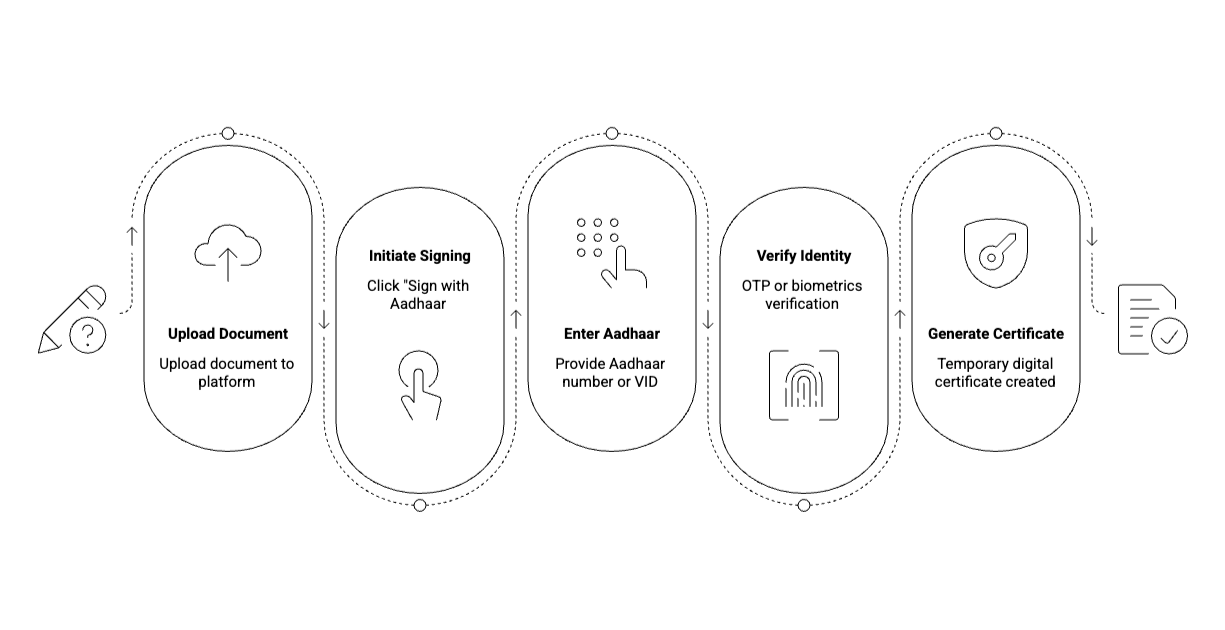
Workflow: From Upload to Digital Signature
- Upload the Document – Upload the document you want to sign to the platform.
- Initiate Aadhaar eSign – Click the "Sign with Aadhaar" option to begin the signing process.
- Enter Aadhaar Details – Provide your Aadhaar number or Virtual ID (VID).
- Verify Your Identity – Authenticate yourself using the OTP sent to your registered mobile number or biometric verification (where applicable).
- Generate the Digital Signature – Once verification is successful, a one-time Digital Signature Certificate (DSC) is generated, and your document is digitally signed.
- Download the Signed Document – Your Aadhaar eSigned document is ready to download or securely share.
Is Aadhaar eSign Safe?
The short answer is yes. Aadhaar eSign is built with multiple security measures that help protect both your identity and the documents you sign.
Here are a few reasons why it's considered secure:
Identity Verification
Before your signature is applied, you must verify your identity using an OTP sent to your Aadhaar-linked mobile number or, in some cases, biometric authentication. This helps ensure that only the Aadhaar holder can complete the signing process.
Tamper-Evident Documents
Once a document is signed, any changes made to it can be detected. This helps preserve the integrity of the document and lets recipients know if it has been modified after signing.
Encryption and PKI
Aadhaar eSign uses Public Key Infrastructure (PKI) and digital certificates issued by licensed Certifying Authorities (CAs). These technologies help ensure that the signature is authentic and that the document hasn't been altered.
Audit Trails
Most Aadhaar eSign platforms also maintain an audit trail containing:
- The signing timestamp
- Authentication information
- Transaction logs
These records provide additional evidence of the signing process and can be useful if the document is ever disputed.
An example of the audit trail is shown below:

Keep These Best Practices in Mind
Even though Aadhaar eSign is secure, it's always a good idea to follow a few basic precautions:
- Never share the OTP sent to your Aadhaar-linked mobile number.
- Keep your Aadhaar-linked mobile number updated and secure.
- Use a trusted Aadhaar eSign platform or service provider.
- Review the document carefully before signing.
When used correctly, Aadhaar eSign offers a secure and convenient way to sign documents online.
Final Thoughts
As more services move online, Aadhaar eSign has made signing documents faster, easier, and more secure. From employment contracts and rental agreements to other everyday paperwork, it offers a convenient way to complete the signing process without printing, scanning, or visiting an office.
With UIDAI-based identity verification and legal recognition under Indian law, Aadhaar eSign provides a trusted way to sign eligible documents digitally while helping reduce paperwork and save time.
At Realtimate, we use Aadhaar eSign to simplify the agreement process from start to finish. Whether you're creating a Rental Agreement, Sale Agreement, Service Agreement, Memorandum of Understanding (MoU), Release Agreement, or any other agreement that can be legally eSigned, our platform helps you draft, e-stamp (where applicable), and sign documents online in just a few steps.
If you're looking for a faster, paperless way to manage agreements, Aadhaar eSign makes the process simple, secure, and legally recognised for eligible documents.
Ready to sign agreements online? Visit Realtimate to create, e-stamp (where applicable), and securely sign your agreements using Aadhaar eSign, all from one platform.
Frequently Asked Questions:
Is Aadhaar eSign legally valid?
Yes. Aadhaar eSign is legally recognised under the Information Technology Act, 2000 and the Information Technology (Electronic Signature or Electronic Authentication Technique and Procedure) Rules, 2015.
Can I use Aadhaar eSign on my phone?
Yes. Most Aadhaar eSign platforms work on smartphones without requiring any additional software.
Is Aadhaar eSign free?
Some platforms include Aadhaar eSign as part of their service, while others may charge a small fee per signature.
Is a scanned signature legally valid?
A scanned signature may be valid depending on the circumstances, but it does not provide the same level of identity verification as Aadhaar eSign.